
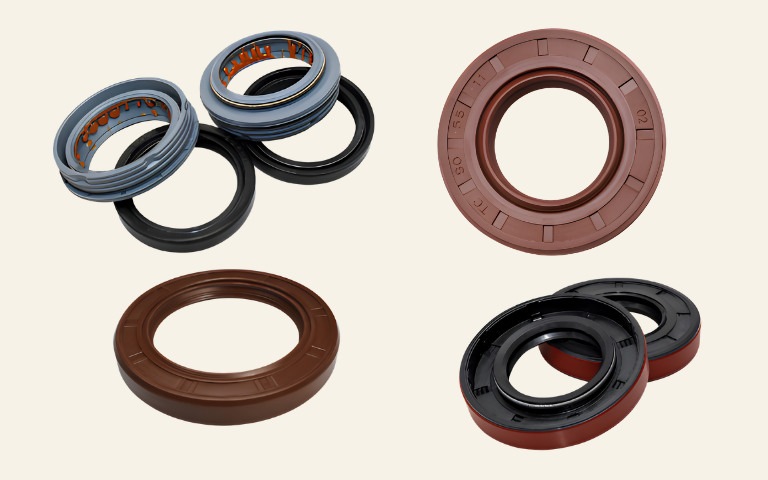
Industrial Oil Seals: Types, Applications and Selection Guide
Industrial Oil Seals: Types, Applications and Selection Guide
Industrial machinery contains numerous rotating and moving components that require lubrication for effective operation. At the same time, lubricants need to remain within their intended areas while contaminants such as dust, dirt and moisture need to be kept away from sensitive components.
This is one of the important functions of an industrial oil seal.
Oil seals are used in various mechanical assemblies to help retain lubricants and support the protection of components around rotating shafts. The correct seal depends on factors such as shaft dimensions, housing dimensions, operating conditions, temperature, fluid compatibility and application requirements.
Labdhi Engineering Co. lists several oil-seal categories, including industrial oil seals, oil seal kits, silicone oil seals, SKF oil seals and Viton oil seals.
What Is an Industrial Oil Seal?
An industrial oil seal is a sealing component used around a shaft or similar moving interface.
Its purpose is generally to help:
- Retain lubricants
- Reduce leakage
- Protect components from contaminants
- Support reliable operation of rotating machinery
- Maintain the sealing interface around moving components
Oil seals are used in many types of industrial machinery where shafts rotate within housings.
Why Are Oil Seals Important?
Lubrication plays an important role in machinery containing bearings, shafts and other moving components.
If lubricant escapes from the intended area, or contaminants enter the assembly, machine performance and component life can be affected.
A suitable oil seal can therefore form an important part of the overall mechanical assembly.
However, choosing a seal should not be based only on its outside appearance or general size.
The dimensions, material and operating conditions need to be considered together.
Common Types of Industrial Oil Seals
Labdhi’s website lists multiple oil-seal product categories.
1. Industrial Oil Seals
Industrial oil seals are designed for use in machinery and mechanical assemblies where shaft sealing is required.
The correct product depends on the dimensions and operating conditions of the equipment.
2. Silicone Oil Seals
Silicone oil seals are another category listed by Labdhi.
When considering a silicone seal, buyers should evaluate the application conditions and verify material suitability for the intended temperature, fluid and mechanical environment.
3. SKF Oil Seals
Labdhi’s oil-seal category includes SKF oil seals.
For branded sealing products, buyers should confirm the exact part number, dimensions and application requirements before placing an order.
4. Viton Oil Seals
Viton oil seals are also listed in Labdhi’s product category.
For any seal material, the operating environment should be reviewed before selection, especially where temperature, fluids or chemicals are involved.
5. Oil Seal Kits
Oil seal kits can be useful where multiple sealing components are required for maintenance or equipment servicing.
The exact kit contents and compatibility should be confirmed according to the equipment and application.
How to Choose the Right Industrial Oil Seal
Choosing the correct oil seal starts with accurate application information.
1. Identify the Shaft Diameter
The shaft diameter is one of the basic dimensions required when selecting a seal.
An incorrect shaft dimension can result in an unsuitable sealing fit.
Measure or confirm the shaft specification before ordering.
2. Check the Housing or Bore Diameter
The housing dimension is also important.
The seal must fit correctly into its designated housing.
Therefore, both shaft and housing dimensions should be considered rather than selecting a seal based only on one measurement.
3. Confirm Seal Width
Seal width is another dimensional factor that should be verified.
Available installation space can vary between machines, so the seal width should match the intended housing arrangement.
4. Consider Operating Temperature
Temperature can influence the suitability of a sealing material.
Machinery operating at elevated or fluctuating temperatures may require a seal material appropriate for those conditions.
Always verify the manufacturer’s specifications for the selected product.
5. Consider the Fluid or Lubricant
The seal material should be compatible with the fluid or lubricant used in the application.
Different machinery may use different oils, greases or process fluids.
Therefore, buyers should provide information about the fluid when seeking technical guidance.
6. Consider Shaft Speed
Rotating shaft speed can affect sealing requirements.
A seal used on a slowly rotating shaft may have different requirements from one used in a high-speed application.
Provide the operating speed when discussing an oil-seal requirement with a supplier.
7. Evaluate the Operating Environment
The surrounding environment can also influence seal selection.
Consider whether the machinery is exposed to:
- Dust
- Water
- Moisture
- Chemicals
- Heat
- Dirt
- Industrial contaminants
The seal should be selected according to the actual conditions in which it will operate.
Applications of Industrial Oil Seals
Oil seals can be used across different types of industrial machinery and mechanical systems.
Potential applications include:
- Motors
- Pumps
- Gearboxes
- Rotating machinery
- Industrial equipment
- Power-transmission systems
- Machinery maintenance
- Mechanical assemblies
The correct product should always be determined according to the equipment manufacturer’s requirements and the specific application.
Oil Seal Selection: Information to Provide a Supplier
When requesting an industrial oil seal, providing complete information can make the selection process easier.
A useful specification checklist includes:
| Parameter | Information |
|---|---|
| Shaft Diameter | Actual shaft size |
| Housing Diameter | Seal housing or bore size |
| Seal Width | Available installation width |
| Shaft Speed | Operating RPM |
| Temperature | Normal and maximum operating temperature |
| Fluid | Oil, grease or other fluid |
| Environment | Dust, water, chemicals and other exposure |
| Equipment | Machine or assembly where the seal is used |
| Existing Seal | Part number or dimensions, if available |
| Quantity | Required number of seals |
If an existing seal is being replaced, providing the old seal’s part number, dimensions or a clear product photograph can also help identify the required replacement.
Common Mistakes When Buying Oil Seals
Choosing Only by Outside Diameter
A seal should not be selected using only the outside diameter.
Shaft diameter, width and other specifications also need to match the application.
Ignoring Operating Conditions
Temperature, speed and fluid compatibility can all influence seal selection.
Ignoring these factors can lead to an unsuitable product.
Not Checking the Part Number
For branded products, the exact part number should be verified before ordering.
A similar-looking seal may not necessarily have the same specifications.
Using Incorrect Measurements
Small dimensional differences can matter in sealing applications.
Measurements should therefore be taken carefully using suitable measuring equipment or confirmed from equipment documentation.
Not Communicating the Application
A supplier needs to understand where the seal will be used.
Providing the machine type and operating conditions can make technical product selection more precise.
Industrial Oil Seals for Maintenance and Replacement
Oil seals are often replaced as part of machinery maintenance.
During replacement, technicians should check the surrounding components rather than treating the seal as an isolated part.
For example, it can be useful to inspect:
- Shaft condition
- Housing condition
- Existing seal
- Lubricant condition
- Bearing arrangement
- Installation area
If the shaft or housing has damage or wear, simply replacing the seal may not address the underlying issue.
Selecting a Supplier for Industrial Oil Seals
For industrial procurement, the supplier should be able to provide the required product information and help identify suitable options.
Important purchasing considerations can include:
- Correct dimensions
- Product category
- Brand requirements
- Material requirements
- Application suitability
- Quantity
- Availability
- Replacement requirements
- Delivery requirements
Labdhi Engineering Co. is based in Masjid Bandar, Mumbai, and its website lists oil seals alongside a broader range of industrial products.
Frequently Asked Questions
What is an industrial oil seal used for?
An industrial oil seal is generally used to help retain lubricants and protect mechanical assemblies from contaminants around rotating or moving components.
How do I choose an oil seal?
Consider the shaft diameter, housing diameter, seal width, operating speed, temperature, fluid and environmental conditions.
What information is needed to order an oil seal?
At minimum, provide accurate shaft and housing dimensions. Information about operating speed, temperature, fluid and application can also help with product selection.
What types of oil seals are available from Labdhi?
Labdhi’s website lists industrial oil seals, oil seal kits, silicone oil seals, SKF oil seals and Viton oil seals.
Can an oil seal be selected using only its size?
Size is an important starting point, but it is not the only consideration. Material, operating conditions, speed, fluid compatibility and application should also be reviewed.
Conclusion
Industrial oil seals are important components in many mechanical assemblies where lubricant retention and contamination control are required.
Selecting the appropriate seal involves more than matching a dimension. Shaft size, housing size, width, speed, temperature, fluid and operating environment should all be considered.
Labdhi Engineering Co.’s oil-seal range includes industrial oil seals, oil seal kits, silicone oil seals, SKF oil seals and Viton oil seals, giving industrial buyers several categories to evaluate according to their requirements.
For oil-seal requirements, providing accurate dimensions and complete application information can help identify a suitable product for the intended machinery.